Programming

Rust 1.0 Released 149

TopSpin writes: Rust 1.0 has arrived, and release parties in Paris, LA and San Francisco are taking place today. From the Rust Programming Language blog: "The current Rust language is the result of a lot of iteration and experimentation. The process has worked out well for us: Rust today is both simpler and more powerful than we originally thought would be possible. But all that experimentation also made it difficult to maintain projects written in Rust, since the language and standard library were constantly changing. The 1.0 release marks the end of that churn. This release is the official beginning of our commitment to stability, and as such it offers a firm foundation for building applications and libraries. From this point forward, breaking changes are largely out of scope (some minor caveats apply, such as compiler bugs)." You can read about specific changes in the changelog.
Operating Systems

MenuetOS, an Operating System Written Entirely In Assembly, Hits 1.0 368

angry tapir writes: MenuetOS, a GUI-toting, x86-based operating system written entirely in assembly language that's super-fast and can fit on a floppy disk, has hit version 1.0 — after almost a decade and a half of development. (And yes, it can run Doom). The developers say it's stable on all hardware with which they've tested it. In this article, they talk about what MenuetOS can do, and what they plan for the future. "For version 2.0 we'll mostly keep improving different application classes, which are already present in 1.00. For example, more options for configuring the GUI and improving the HTTP client. The kernel is already working well, so now we have more time to focus on driver and application side."
Programming

Is Agile Development a Failing Concept? 507

Nerval's Lobster writes: Many development teams have embraced Agile as the ideal method for software development, relying on cross-functional teams and adaptive planning to see their product through to the finish line. Agile has its roots in the Agile Manifesto, the product of 17 software developers coming together in 2001 to talk over development methods. And now one of those developers, Andy Hunt, has taken to his blog to argue that Agile has some serious issues. Specifically, Hunt thinks a lot of developers out there simply aren't adaptable and curious enough to enact Agile in its ideal form. 'Agile methods ask practitioners to think, and frankly, that's a hard sell,' Hunt wrote. 'It is far more comfortable to simply follow what rules are given and claim you're 'doing it by the book.'' The blog posting offers a way to power out of the rut, however, and it centers on a method that Hunt refers to as GROWS, or Growing Real-World Oriented Working Systems. In broad strokes, GROWS sounds a lot like Agile in its most fundamental form; presumably Hunt's future postings, which promise to go into more detail, will show how it differs. If Hunt wants the new model to catch on, he may face something of an uphill battle, given Agile's popularity.
Open Source

RTFM? How To Write a Manual Worth Reading 244

An anonymous reader writes with a link to Rich Bowen's insightful, detail laden piece at Opensource.com about improving documentation: Have you noticed that the more frequently a particular open source community tells you to RTFM, the worse the FM is likely to be? I've been contemplating this for years, and have concluded that this is because patience and empathy are the basis of good documentation, much as they are the basis for being a decent person. What's the best example you know of for open-source documentation? How about the worst?
Programming

Ask Slashdot: Security Certification For an Old Grad? 125

An anonymous reader writes: I graduated in late 2003 during the tech bubble burst with a below 2.5 GPA. I am 35 with an interest in getting a security job. What are the chances that I would be just wasting my time and money? I am pursuing business interests with a patent used in a service that will be a prime target for hackers. I have been writing client/server software in an OpenBSD virtual machine for the security and the kqueue functionality; not to mention the rest of the virtual clients crash that I have tried. I figure that trying to sell the service idea, even if I can't get a job, when they ask what qualifies me to have such ideas, I can say I have the credentials. I just got issued the patent this year. What would you do in this situation to be a viable candidate for employment?
Programming

Criticizing the Rust Language, and Why C/C++ Will Never Die 386

An anonymous reader sends an article taking a harsh look at Rust, the language created by Mozilla Research, and arguing that despite all the flaws of C and C++, the two older languages are likely to remain in heavy use for a long time to come. Here are a few of the arguments: "[W]hat actually makes Rust safe, by the way? To put it simple, this is a language with a built-in code analyzer and it's a pretty tough one: it can catch all the bugs typical of C++ and dealing not only with memory management, but multithreading as well. Pass a reference to an assignable object through a pipe to another thread and then try to use this reference yourself - the program just will refuse to compile. And that's really cool. But C++ too hasn't stood still during the last 30 years, and plenty of both static and dynamic analyzers supporting it have been released during this time."

Further, "Like many of new languages, Rust is walking the path of simplification. I can generally understand why it doesn't have a decent inheritance and exceptions, but the fact itself that someone is making decisions for me regarding things like that makes me feel somewhat displeased. C++ doesn't restrict programmers regarding what they can or cannot use." And finally, "I can't but remind you for one more time that the source of troubles is usually in humans, not technology . If your C++ code is not good enough or Java code is painfully slow, it's not because the technology is bad - it's because you haven't learned how to use it right. That way, you won't be satisfied with Rust either, but just for some other reasons."
Open Source

Open Source C++ ClanLib SDK Refreshed For 2015 47

New submitter rombust writes: Will ClanLib turn around the tides and finally challenge SDL? The latest 4.0 release already offers what Unity and the Unreal Engine charges 30% for, but now after 16 years of development, using only hobbyist developers, it will take on the giant of open source game SDKs! Dedication that's rarely found in the Open Source community without commercial backing.
IOS

Swift Vs. Objective-C: Why the Future Favors Swift 270

snydeq writes: InfoWorld's Paul Solt argues that It's high time to make the switch to the more approachable, full-featured Swift for iOS and OS X app dev. He writes in Infoworld: "Programming languages don't die easily, but development shops that cling to fading paradigms do. If you're developing apps for mobile devices and you haven't investigated Swift, take note: Swift will not only supplant Objective-C when it comes to developing apps for the Mac, iPhone, iPad, Apple Watch, and devices to come, but it will also replace C for embedded programming on Apple platforms. Thanks to several key features, Swift has the potential to become the de-facto programming language for creating immersive, responsive, consumer-facing applications for years to come."
Programming

Ask Slashdot: How To Own the Rights To Software Developed At Work? 353

New submitter ToneyTime writes: I'm a young developer building custom add-ins for my company's chosen SAAS platform as a full time staff member. The platform supports a developer community to share code and plug-ins with an option to sell the code. While I don't plan on having a breakthrough app, I am interested in sharing the solutions I create, hopefully with the potential of selling. All solutions are created and made by me for business needs, and I aim to keep any company's specific data out. I have a good relationship with management and can develop on my own personal instance of the platform, but would be doing so on company time. Going contractor is a bit premature for me at this stage. Any advice, references or stories to learn from?
Businesses

FWD.us To Laid-Off Southern California Edison Workers: Boo-Hoo 612

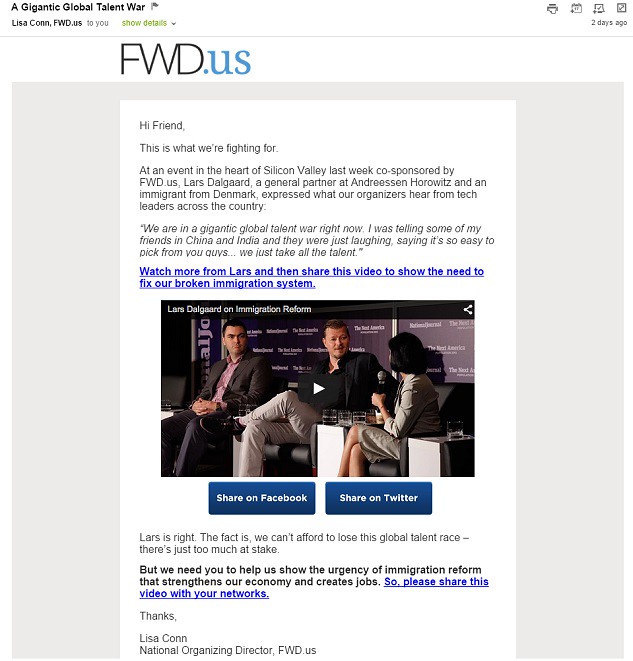
theodp writes: Speaking at a National Journal LIVE event that was sponsored by Mark Zuckerberg's FWD.us and Laurene Powell Jobs' Emerson Collective, FWD.us "Major Contributor" Lars Dalgaard was asked about the fate of 500 laid-off Southern California Edison IT workers, whose forced training of their H-1B worker replacements from offshore outsourcing companies sparked a bipartisan Senate investigation. "If you want the job, make yourself able to get the job," quipped an unsympathetic Dalgaard (YouTube). "Nobody's going to hold you up and carry you around...If you're not going to work hard enough to be qualified to get the job...well then, you don't deserve the job." "That might be harsh," remarked interviewer Niharika Acharya. Turning to co-interviewee Pierre-Jean Cobut, FWD.us's poster child for increasing the H-1B visa cap, Acharya asked, "Do you agree with him?" "Actually, I do," replied PJ, drawing laughs from the crowd.
Businesses

Ask Slashdot: Moving To an Offshore-Proof Career? 420

New submitter sundarvenkata writes: I am sure most slashdotters (including the ones who had the I-am-an-indispensable-snowflake stance in the past) have already foreseen the writing on the wall for the future of tech professions (with IT being the worst hit) given some of the ominous news in the past few years: here, here and here. Of course, there are always the counter-arguments put forth by slashdotters that "knowing the business" or "being the best in what you do" would save one's derriere as if the offshore workers will remain permanently impaired of such skills. But I was wondering if some slashdotters could share some constructive real-life experiences of planning a transition to a relatively offshore-proof career. If you have already managed to accomplish such a career change, what was your journey and what would your advice be to other aspirants?
United States

Microsoft-Backed Think Tank: K-12 CS Education Cure For Sagging US Productivity 131

theodp writes: On May 6, notes think tank Brookings, the Department of Labor released labor productivity data showing that output per worker fell by 1.9 percent during the first quarter of 2015. But fear not — the Metropolitan Policy Program of [Microsoft-backed] Brookings says K-12 computer science education is the cure for what ails U.S. productivity: "So how can the United States reverse this trend? First, states, metropolitan areas, and school districts must recognize that basic digital literacy is no longer sufficient preparation for the 21st century workforce. Familiarity with higher-level skills such as coding will be critical as the role of technology continues to grow. The 60-plus school districts that have partnered with [Microsoft-backed] Code.org have already begun to move in this direction. By introducing students to computer science fundamentals early on, Code.org and its partner districts will help get more people on pathways to well-paying jobs in computer programming and other fields." Creating a national K-12 CS and tech immigration crisis was proposed as Microsoft introduced its 'two-pronged' National Talent Strategy to increase K-12 CS education and the number of H-1B visas at a Brookings event in 2012. While creating a K-12 CS crisis fell to Code.org, fanning the flames of a tech immigration crisis is the purvey of [Microsoft exec-backed] FWD.us, the PAC formed by Facebook CEO Mark Zuckerberg, which recently sent an email blast warning U.S. citizens they're in 'A Gigantic Global Talent War', adding that China and India citizens are "just laughing [at the US], saying it's so easy to pick from you guys... we just take all the talent."
Windows

Future Holds Large Updates Instead of Stand-Alone Windows Releases 199

jones_supa writes: Jerry Nixon, a Microsoft developer evangelist, said at the Ignite conference in Chicago that Windows 10 "is the last version of Windows, so we're always working on Windows 10." Saying that is only half true. In fact, Microsoft will start working on large updates instead of stand-alone Windows releases, so the company would switch from a model that previously brought us new versions of Windows every three years, to a simpler one that's likely to bring big updates every two months. The company will also change the naming system for Windows, so instead of Windows $(version), the new operating system would be simply called Windows.
Programming

Why Companies Should Hire Older Developers 429

Nerval's Lobster writes: Despite legislation making it overtly illegal, ageism persists in the IT industry. If you're 40 or older, you've probably seen cases where younger developers were picked over older ones. At times we're told there's a staffing crisis, that companies need to import more developers via H-1B, but the truth is that outsourcing and downsizing eliminated a subset of viable developers from the market. Those developers, in turn, had to figure out if they wanted to land another job, freelance, or leave the technology industry entirely. But older developers still have a lot to offer, developer David Bolton writes in a new column: They have decades of experience (and specialist knowledge), they have a healthy disregard for office politics (but can still manage, when necessary), they're available, and they're (generally) stable.
Programming

C Code On GitHub Has the Most "Ugly Hacks" 264

itwbennett writes: An analysis of GitHub data shows that C developers are creating the most ugly hacks — or are at least the most willing to admit to it. To answer the question of which programming language produces the most ugly hacks, ITworld's Phil Johnson first used the search feature on GitHub, looking for code files that contained the string 'ugly hack'. In that case, C comes up first by a wide margin, with over 181,000 code files containing that string. The rest of the top ten languages were PHP (79k files), JavaScript (38k), C++ (22k), Python (19k), Text (11k), Makefile (11k), HTML, (10k), Java (7k), and Perl (4k). Even when controlling for the number of repositories, C wins the ugly-hack-athon by a landslide, Johnson found.
Open Source

Why Was Linux the Kernel That Succeeded? 469

jones_supa writes: "One of the most puzzling questions about the history of free and open source software is this: Why did Linux succeed so spectacularly, whereas similar attempts to build a free or open source, Unix-like operating system kernel met with considerably less success?" Christopher Tozzi has rounded up some theories, focusing specifically on kernels, not complete operating systems. These theories take a detailed look at the decentralized development structure, pragmatic approach to things, and the rich developer community, all of which worked in favor of Linux.
Programming

Is It Worth Learning a Little-Known Programming Language? 267

Nerval's Lobster writes: Ask a group of developers to rattle off the world's most popular programming languages, and they'll likely name the usual suspects: JavaScript, Java, Python, Ruby, C++, PHP, and so on. Ask which programming languages pay the best, and they'll probably list the same ones, which makes sense. But what about the little-known languages and skill sets (Dice link) that don't leap immediately to mind but nonetheless support some vital IT infrastructure (and sometimes, as a result, pay absurdly well)? is it worth learning a relatively obscure language or skill set, on the hope that you can score one of a handful of well-paying jobs that require it? The answer is a qualified yes—so long as the language or skill set in question is clearly on the rise. Go, Swift, Rust, Julia and CoffeeScript have all enjoyed rising popularity, for example, which increases the odds that they'll remain relevant for at least the next few years. But a language without momentum behind it probably isn't worth your time, unless you want to learn it simply for the pleasure of learning something new.
Bug

The BBC Looks At Rollover Bugs, Past and Approaching 59

New submitter Merovech points out an article at the BBC which makes a good followup to the recent news (mentioned within) about a bug in Boeing's new 787. The piece explores various ways that rollover bugs in software have led to failures -- some of them truly disastrous, others just annoying. The 2038 bug is sure to bite some people; hopefully it will be even less of an issue than the Year 2000 rollover. From the article: It was in 1999 that I first wrote about this," comments [programmer William] Porquet. "I acquired the domain name 2038.org and at first it was very tongue-in-cheek. It was almost a piece of satire, a kind of an in-joke with a lot of computer boffins who say, 'oh yes we'll fix that in 2037' But then I realised there are actually some issues with this.
Programming

The Programming Talent Myth 425

HughPickens.com writes: Jake Edge writes at LWN.net that there is a myth that programming skill is somehow distributed on a U-shaped curve and that people either "suck at programming" or that they "rock at programming", without leaving any room for those in between. Everyone is either an amazing programmer or "a worthless use of a seat" which doesn't make much sense. If you could measure programming ability somehow, its curve would look like the normal distribution. According to Edge this belief that programming ability fits into a bi-modal distribution is both "dangerous and a myth". "This myth sets up a world where you can only program if you are a rock star or a ninja. It is actively harmful in that is keeping people from learning programming, driving people out of programming, and it is preventing most of the growth and the improvement we'd like to see." If the only options are to be amazing or terrible, it leads people to believe they must be passionate about their career, that they must think about programming every waking moment of their life. If they take their eye off the ball even for a minute, they will slide right from amazing to terrible again leading people to be working crazy hours at work, to be constantly studying programming topics on their own time, and so on.

The truth is that programming isn't a passion or a talent, says Edge, it is just a bunch of skills that can be learned. Programming isn't even one thing, though people talk about it as if it were; it requires all sorts of skills and coding is just a small part of that. Things like design, communication, writing, and debugging are needed. If we embrace this idea that "it's cool to be okay at these skills"—that being average is fine—it will make programming less intimidating for newcomers. If the bar for success is set "at okay, rather than exceptional", the bar seems a lot easier to clear for those new to the community. According to Edge the tech industry is rife with sexism, racism, homophobia, and discrimination and although it is a multi-faceted problem, the talent myth is part of the problem. "In our industry, we recast the talent myth as "the myth of the brilliant asshole", says Jacob Kaplan-Moss. "This is the "10x programmer" who is so good at his job that people have to work with him even though his behavior is toxic. In reality, given the normal distribution, it's likely that these people aren't actually exceptional, but even if you grant that they are, how many developers does a 10x programmer have to drive away before it is a wash?"

Slashdot Top Deals