Education

White House Touts Obama's 1-Liner as 2014 Tech Highlight 65

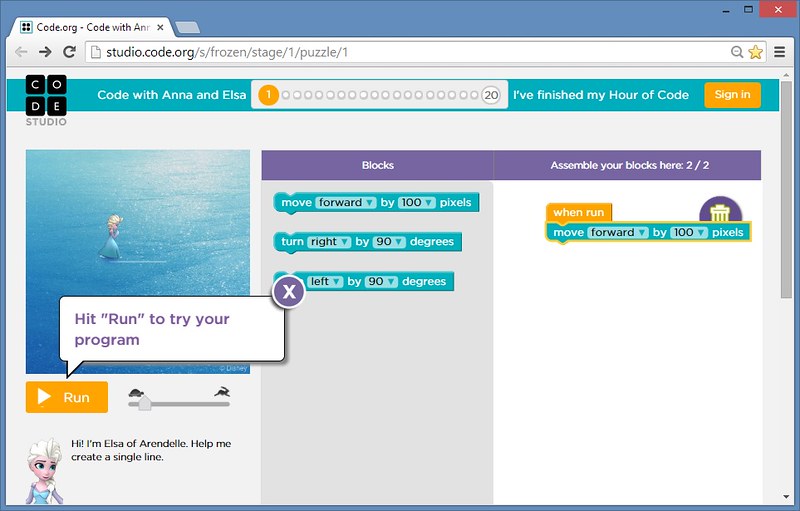
theodp (442580) writes That President Obama became the first President to write a line of code (as a top Microsoft lobbyist looked on) is #1 on the White House's Top 9 science and technology highlights from 2014. To kick off this year's Hour of Code, the President 'learned to code' by moving a Disney Princess Elsa character 100 pixels on a screen, first by dragging-and-dropping Blockly puzzle pieces and then by coding 1 line of JavaScript. Interestingly, Bill Clinton might have been The First President To Write Code had Microsoft seen fit to use its patented, circa-1995 Graphical Programming System and Method for Enabling a Person to Learn Text-Based Programming — which describes how kids as young as 8-12 years of age can be taught to program by progressing from creating a program using graphical objects to doing so using text-based programming — to teach President Clinton to code some 20 years ago!
Programming

Paul Graham: Let the Other 95% of Great Programmers In 552

An anonymous reader writes: Y Combinator's Paul Graham has posted an essay arguing in favor of relaxed immigration rules. His argument is straight-forward: with only 5% of the world's population, the U.S. can only expect about 5% of great programmers to be born here. He says, "What the anti-immigration people don't understand is that there is a huge variation in ability between competent programmers and exceptional ones, and while you can train people to be competent, you can't train them to be exceptional. Exceptional programmers have an aptitude for and interest in programming that is not merely the product of training."

Graham says even a dramatic boost to the training of programmers within the U.S. can't hope to match the resources available elsewhere. "We have the potential to ensure that the U.S. remains a technology superpower just by letting in a few thousand great programmers a year. What a colossal mistake it would be to let that opportunity slip. It could easily be the defining mistake this generation of American politicians later become famous for."
Databases

Net Neutrality Comments Overtaxed FCC's System 32

Presto Vivace writes with news that the FCC has had trouble dealing with the sheer volume of comments submitted about net neutrality. There were millions of them, and they caused problems with the agency's 18-year-old Electronic Comment Filing System (ECFS). When the FCC attempted to dump the comments into XML format to make download and analysis easier, problems with Apache Solr meant roughly 680,000 didn't make the transfer. The agency promised to release a new set of fixed XML files in January that include all of the dropped comments. Despite many reports that the comments were "lost," they're all available using the ECFS.
Programming

Donald Knuth Worried About the "Dumbing Down" of Computer Science History 149

An anonymous reader writes: Thomas Haigh, writing for Communications of the ACM, has an in-depth column about Donald Knuth and the history of computer science. It's centered on a video of Knuth giving a lecture at Stanford earlier this year, in which he sadly recounts how we're doing a poor job of capturing the development of computer science, which obscures vital experience in discovering new concepts and overcoming new obstacles. Haigh disagrees with Knuth, and explains why: "Distinguished computer scientists are prone to blur their own discipline, and in particular few dozen elite programs, with the much broader field of computing. The tools and ideas produced by computer scientists underpin all areas of IT and make possible the work carried out by network technicians, business analysts, help desk workers, and Excel programmers. That does not make those workers computer scientists. ... Computing is much bigger than computer science, and so the history of computing is much bigger than the history of computer science. Yet Knuth treated Campbell-Kelly's book on the business history of the software industry (accurately subtitled 'a history of the software industry') and all the rest of the history of computing as part of 'the history of computer science.'"
Programming

MIT Unifies Web Development In Single, Speedy New Language 194

itwbennett writes: A new programming language out of MIT, called Ur/Web, provides a way for developers to write pages as self-contained programs. It incorporates many of the most widely-used web technologies, freeing developers from working with each language individually. Ur/Web's author, Adam Chlipala, an MIT computer science assistant professor, will present his work next month at the Association for Computing Machinery's Symposium on Principles of Programming Languages. He says, "In Ur/Web, everything is based on transactions, where a single client request is handled by what looks like an uninterrupted execution of a single function. The language implementation has optimizations in it to support running many requests in parallel, on real servers. But the programmer can pretend everything is a transaction and think in a simpler concurrency model."
Government

North Korean Defector Spills Details On the Country's Elite Hacking Force 166

mattydread23 writes Business Insider interviewed Jang Se-yul, a North Korean defector who trained in the country's Mirim University alongside some of the hackers who make up its elite Bureau 121 hacking squad. He explains how they train: 'They take six 90-minute classes every day, learning different coding languages and operating systems, from C to Linux. Jang says a lot of time was spent dissecting Microsoft programs, like the Windows operating system, and how to attack the overall computer IT systems of enemy countries like the U.S. or South Korea.' He also explains that these hackers are among the elite in North Korea, and even though they have unfiltered information about the outside world that their countrymen lack, most of them would never dream of leaving. (See also this story from earlier this month about the life of North Korea's elite hackers.)
Open Source

Subsurface 4.3 Released 38

jones_supa writes "The Subsurface development team proudly announces release 4.3 of the open source divelog and dive planning program, available for all major desktop operating systems. This is the software originally founded by Linus Torvalds, and the development seems to be continuing in great pace. Subsurface now supports flexible filtering of the dive list based on criteria like tags, people or gear. Dive characteristics can now also be copied and pasted to other dives. The dive profile now offers an easy to understand tissue saturation graph that shows tissue saturation at any point during the dive. As another new feature in the dive profile, one can turn on an improved visualization of the gas combinations used during a dive. The dive computer and file format support have also gotten large improvements."
Microsoft

Ask Slashdot: Is an Open Source .NET Up To the Job? 421

Rob Y. writes: The discussion on Slashdot about Microsoft's move to open source .NET core has centered on:

1. whether this means Microsoft is no longer the enemy of the open source movement
2. if not, then does it mean Microsoft has so lost in the web server arena that it's resorting to desperate moves.
3. or nah — it's standard Microsoft operating procedure. Embrace, extend, extinguish.

What I'd like to ask is whether anybody that's not currently a .NET fan actually wants to use it? Open source or not. What is the competition? Java? PHP? Ruby? Node.js? All of the above? Anything but Microsoft? Because as an OSS advocate, I see only one serious reason to even consider using it — standardization. Any of those competing platforms could be as good or better, but the problem is: how to get a job in this industry when there are so many massively complex platforms out there. I'm still coding in C, and at 62, will probably live out my working days doing that. But I can still remember when learning a new programming language was no big deal. Even C required learning a fairly large library to make it useful, but it's nothing compared to what's out there today. And worse, jobs (and technologies) don't last like they used to. Odds are, in a few years, you'll be starting over in yet another job where they use something else.

Employers love standardization. Choosing a standard means you can't be blamed for your choice. Choosing a standard means you can recruit young, cheap developers and actually get some output from them before they move on. Or you can outsource with some hope of success (because that's what outsourcing firms do — recruit young, cheap devs and rotate them around). To me, those are red flags — not pluses at all. But they're undeniable pluses to greedy employers. Of course, there's much more to being an effective developer than knowing the platform so you can be easily slotted in to a project. But try telling that to the private equity guys running too much of the show these days.

So, assuming Microsoft is sincere about this open source move,
1. Is .NET up to the job?
2. Is there an open source choice today that's popular enough to be considered the standard that employers would like?
3. If the answer to 1 is yes and 2 is no, make the argument for avoiding .NET.
Education

Ask Slashdot: Resources For Kids Who Want To Make Games? 121

Mr. Jones writes: My 11-year-old son is fascinated by games — game mechanics in particular. He has been playing everything from Magic to WarFrame since he was 5 years old. He seems mostly interested in creating the lore and associated mechanics of the games (i.e. how a game works). If it was only programming I could help him, but I am lost when it comes to helping him learn more formal ways of developing and defining gameplay. I really see a talent for this in him and I want to support it any way I can. Can you suggest any conferences, programs, books, websites, etc. that would help him learn?
Programming

Hackers' Shutdown of 'The Interview' Confirms Coding Is a Superpower 221

theodp writes: The idea of programming as a superpower was touched upon by CS teacher Alfred Thompson back in 2010, but it became a rallying call of sorts for the Hour of Code after Dropbox CEO Drew Houston described coding as "the closest thing we have to a superpower" in a Code.org video that went viral. And if the kids who learned to code with the President last week were dubious about the power of coding, this week's decision by Sony to scrap the release of the satirical film The Interview after a massive hack attack should put aside any doubts, especially after new revelations that Sony had reached out to the White House for help and screened the film for administration officials back in June. White House press secretary Josh Earnest said Thursday that the Obama Administration is viewing the Sony attack as a "serious national security matter" and is considering a range of possible options as a response, which could turn things into a contest of U.S. Superpower vs. Coding Superpower. In case it wasn't mentioned last week, remember to always use your coding superpower for good, kids!
Books

Book Review: Build Your Own Website: A Comic Guide to HTML, CSS, and WordPress 31

MassDosage writes "At the the risk of exposing my age I remember building my first website using a rudimentary Unix text editor (Joe) and carefully handcrafting the Hypertext Markup Language (HTML) while directly logged on to the web server it was being served from. Back then Cascading Style Sheets (CSS) weren't even a glint in the eyes of their creators. A lot has changed and there's now a world of fancy WYSIWYG web page editors to choose from as well as Content Management Systems that allow you to create websites without looking at the underlying code at all. While this is all very useful and allows less technical people to create websites I still feel that having at least some knowledge of how everything works under the hood is empowering — especially in situations where you want to go beyond the limits placed on you by a certain tool. This is where Build Your Own Website: A comic guide to HTML, CSS and Wordpress comes into the picture. Its aim is to enable people new to web development to learn the subject by teaching the fundamentals of HTML and CSS first and only then describing how to use a Content Management System (CMS) — in this case Wordpress. While Wordpress might not be everyone's kettle of fish it's a good choice as an example of a modern CMS that is easily accessible and very popular. The concepts presented are simple enough that it should be easy enough for a reader to apply them to a different CMS should they want to. Read below for The rest of MassDosage's review.
Cloud

The Joys and Hype of Hadoop 55

theodp writes "Investors have poured over $2 billion into businesses built on Hadoop," writes the WSJ's Elizabeth Dwoskin, "including Hortonworks Inc., which went public last week, its rivals Cloudera Inc. and MapR Technologies, and a growing list of tiny startups. Yet companies that have tried to use Hadoop have met with frustration." Dwoskin adds that Hadoop vendors are responding with improvements and additions, but for now, "It can take a lot of work to combine data stored in legacy repositories with the data that's stored in Hadoop. And while Hadoop can be much faster than traditional databases for some purposes, it often isn't fast enough to respond to queries immediately or to work on incoming information in real time. Satisfying requirements for data security and governance also poses a challenge."
Programming

New AP Course, "Computer Science Principles," Aims To Make CS More Accessible 208

theodp writes: "CS Principles," explains the intro to a Microsoft Research talk on a new Computer Science Toolkit and Gaming Course, "is a new AP course being piloted across the country and by making it more accessible to students we can help increase diversity in computing." Towards this end, Microsoft has developed "a middle school computing toolkit, and a high school CS Principles & Games course." These two projects were "developed specifically for girls," explains Microsoft, and are part of the corporation's Big Dream Movement for girls, which is partnering with the UN, White House, NSF, EU Commission, and others. One of Microsoft's particular goals is to "reach every individual girl in her house." According to a document on its website, Microsoft Research's other plans for Bridging the Gender Gap in computing include a partnership with the University of Wisconsin "to create a girls-only computer science Massive Open Online Course (MOOC)."
Programming

Dr. Dobb's 38-Year Run Comes To an End 156

An anonymous reader writes: Dr. Dobb's — long time icon of programming magazines — "sunsets" at the end of the year. Editor Andrew Binstock says despite growing traffic numbers, the decline in revenue from ads means there will be no new content posted after 2014 ends. (The site will stay up for at least a year, hopefully longer.) Younger people may not care, but for the hard core old guys, it marks the end of a world where broad knowledge of computers and being willing to create solutions instead of reuse them was valuable. Binstock might disagree; he said, "As our page views show, the need for an independent site with in-depth articles, code, algorithms, and reliable product reviews is still very much present. And I will dearly miss that content. I wish I could point you to another site that does similar work, but alas, I know of none."
Programming

Godot Engine Reaches 1.0, First Stable Release 54

goruka writes "Godot, the most advanced open source (MIT licensed) game engine, which was open-sourced back in February, has reached 1.0 (stable). It sports an impressive number of features, and it's the only game engine with visual tools (code editor, scripting, debugger, 3D engine, 2D engine, physics, multi-platform deploy, etc) on a scale comparable to commercial offerings. As a plus, the user interface runs natively on Linux. Godot has amassed a healthy user community (through forums, Facebook and IRC) since it went public, and was used to publish commercial games in the Latin American and European markets such as Ultimo Carnaval with publisher Square Enix, and The Mystery Team by Sony Computer Entertainment Europe.
Open Source

Microsoft To Open Source Cloud Framework Behind Halo 4 Services 50

angry tapir writes Microsoft plans to open-source the framework that helps developers of cloud services like those behind Halo 4. Project Orleans is a framework built by the eXtreme Computing Group at Microsoft Research using .NET, designed so developers who aren't distributed systems experts can build cloud services that scale to cope with high demand and still keep high performance. The Orleans framework was used to build several services on Azure, including services that are part of Halo 4. The code will be released under an MIT license on GitHub early next year.
Education

Google Suggests Separating Students With 'Some CS Knowledge' From Novices 307

theodp writes To address the challenge of rapidly increasing CS enrollments and increasing diversity, reports the Computing Education Blog, Google in November put out an RFP to universities for its invite-only 3X in 3 Years: CS Capacity Award program, which aims "to support faculty in finding innovative ways to address the capacity problem in their CS courses." In the linked-to RFP document, Google suggests that "students that have some CS background" should not be allowed to attend in-person intro CS courses where they "may be more likely to create a non-welcoming environment," and recommends that they instead be relegated to online courses. According to a recent NSF press release, this recommendation would largely exclude Asian and White boys from classrooms, which seems to be consistent with a Google-CodeCademy award program that offers $1,000 bonuses to teachers who get 10 or more high school kids to take a JavaScript course, but only counts students from "groups traditionally underrepresented in computer science (girls, or boys who identify as African American, Latino, American Indian or Alaska Native)." The project suggested in the Google RFP — which could be worth $1.5 million over 3 years to a large CS department — seems to embrace-and-extend a practice implemented at Harvey Mudd College years ago under President Maria Klawe, which divided the intro CS offering into separate sections based upon prior programming experience to — as the NY Times put it — reduce the intimidation factor of young men, already seasoned programmers, who dominated the class. Google Director of Education and University Relations Maggie Johnson, whose name appears on the CS Capacity RFP, is also on the Board of Code.org (where Klawe is coincidentally an Advisory Board member), the K-12 learn-to-code nonprofit that has received $3+ million from Google and many millions more from other tech giants and their execs. Earlier this week, Code.org received the blessing of the White House and NSF to train 25,000 teachers to teach CS, stirring unease among some educators concerned about the growing influence of corporations in public schools.
Java

Kawa 2.0 Supports Scheme R7RS 62

First time accepted submitter Per Bothner (19354) writes "Kawa is a general-purpose Scheme-based programming language that runs on the Java platform. It combines the strengths of dynamic scripting languages (less boiler-plate, fast and easy start-up, a REPL, no required compilation step) with the strengths of traditional compiled languages (fast execution, static error detection, modularity, zero-overhead Java platform integration).

Version 2.0 was just released with many new features. Most notably is (almost) complete support for the latest Scheme specification, R7RS, which was ratified in late 2013. This LWN article contains a brief introduction to Kawa and why it is worth a look."
Cellphones

Cardboard Hits Half a Million Mark, Gets an SDK 28

PC Magazine reports (citing a blog post from project manager Andrew Nartker) that Google's Cardboard -- first introduced to some laughter -- is growing up, with a small but growing collection of compatible apps and a recently announced SDK. And while Cardboard itself is pretty low-tech (cardboard, rubber band, a magnet) and consequently cheap, the resulting VR experience is pretty good, which explains why more than 500,000 of them have now shipped.
Google

Google Earth API Will Be Retired On December 12, 2015 75

An anonymous reader writes Google [on Friday] announced it plans to retire the Google Earth API on December 12, 2015. The reason is simple: Both Chrome and Firefox are removing support for Netscape Plugin Application Programming Interface (NPAPI) plugins due to security reasons, so the API's death was inevitable. The timing makes sense. Last month, Google updated its plan for killing off NPAPI support in Chrome, saying that it would block all plugins by default in January and drop support completely in September. The company also revealed that the Google Earth plugin had dropped in usage from 9.1 percent of Chrome users in October 2013 to 0.1 percent in October 2014. Add dwindling cross-platform support (particularly on mobile devices), and we're frankly surprised the announcement didn't come sooner.

Slashdot Top Deals