Social Networks

Oxford's Word of the Year: 'Brain Rot' (bbc.com) 75

"Are you spending hours scrolling mindlessly on Instagram reels and TikTok?" asks the BBC. "If so, you might be suffering from brain rot, which has become the Oxford word of the year." It is a term that captures concerns about the impact of consuming excessive amounts of low-quality online content, especially on social media. The word's usage saw an increase of 230% in its frequency from 2023 to 2024. Psychologist and Oxford University Professor, Andrew Przybylski says the popularity of the word is a "symptom of the time we're living in". Brain rot beat five other shortlisted words including demure, Romantasy and dynamic pricing... [And "slop".]

The first recorded use of brain rot dates much before the creation of the internet — it was written down in 1854 by Henry David Thoreau in his book Walden. He criticises society's tendency to devalue complex ideas and how this is part of a general decline in mental and intellectual effort. It leads him to ask: "While England endeavours to cure the potato rot, will not any endeavour to cure the brain-rot — which prevails so much more widely and fatally?" The word initially gained traction on social media among Gen Z and Gen Alpha communities, but it's now being used in the mainstream as a way to describe low-quality, low-value content found on social media.

Prof Przybylski says "there's no evidence of brain rot actually being a thing. Instead it describes our dissatisfaction with the online world and it's a word that we can use to bundle our anxieties that we have around social media."

The New York Times points out that Oxford's past "word of the year" selections included "podcast" and "selfie" [Casper Grathwohl, the president of Oxford Languages, the company's dictionary division] noted the finalists were heavy on old-fashioned words that young people had repurposed in semi-ironic ways — the linguistic equivalent, he said, of "bell-bottoms coming back into fashion...."

"Slop" has undergone a similar update. There was a spike of more than 300 percent over the past year in references not to pig feed, but to "art, writing or other content generated using artificial intelligence, shared and distributed online in an indiscriminate or intrusive way, and characterized as being of low quality, inauthentic or inaccurate," according to Oxford. Like "brain rot," it "represents the underbelly of today's linguistic churn," Grathwohl said. "There's a sense that we are drowning in mediocre experiences as digital lives get clogged."

Social Networks

Bluesky Passes Threads for Active Website Users, But Confronts 'Scammers and Impersonators' (engadget.com) 145

Bluesky (Slashdot is on Bluesky here and Threads here) now has more active website users than Threads in the U.S., according to a graph from the Financial Times. And though Threads still leads in app usage, "Prior to November 5 Threads had five times more daily active users in the U.S. than Bluesky... Now, Threads is only 1.5 times larger than its rival, Similarweb said."

But "the influx of new users has opened up new opportunities for scammers and impersonators," Engadget reported this week: A recent analysis by Alexios Mantzarlis, director of the Security Trust and Safety Initiative at Cornell Tech found that 44 percent of the top 100 most-followed accounts on Bluesky had at least one "doppelganger," with most looking like "cheap knock-offs of the bigger account, down to the same bio and profile picture," Mantzarlis wrote in his newsletter Faked Up.
The article highlighted issues with Bluesky's loose account verification policies. And then, Bluesky announced a new change-of-policy Friday. Engadget reports: The Bluesky Safety account said that the social media service is removing accounts that are impersonating other people and those squatting on handles... Bluesky now requires parody, satire or fan accounts to label themselves as such in both their handles and their bio. If they don't, or if they only indicate the nature of their account in one of those elements, then they'll be treated as an impersonator and will be removed from the platform. Bluesky now explicitly prohibits identity churning, as well. Accounts that start as impersonators with the purpose of gaining new users, and who then switch to a different identity in an attempt to circumvent the ban, will still get booted off the app. Finally, it says it's exploring "additional options to enhance account verification," though they're not quite ready for rollout.
Bluesky says they've "quadrupled the size of our moderation team, in part to action impersonation reports more quickly. We still have a large backlog of moderation reports due to the influx of new users as we shared previously, though we are making progress." And in addition, "We are working behind the scenes to help many organizations and high-profile individuals set up their verified domain handles."

And there's another problem. "The EU's executive arm on Monday said Bluesky didn't provide information it was required to share under the bloc's Digital Services Act," reports Bloomberg. Bluesky responded that it's working to comply, " consulting with its lawyer to follow the EU's information disclosure rules, a Bluesky spokesperson wrote on Tuesday in an email." "All platforms in the EU have to have a dedicated page on their websites where it says how many user numbers they have in the EU and where they are legally established," Thomas Regnier, the commission's spokesperson on digital matters, told reporters. "This is not the case with Bluesky, so this is not followed...."

Under the DSA, platforms with more than 45 million users in the bloc qualify as "very large online platforms" and need to follow stricter content moderation rules under the commission's supervision. Breaches can result in fines of up to 6% of their global annual sales... Smaller platforms are still required to comply with the law, but are regulated by the EU country where they have a legal presence. That's so far unclear in the case of Bluesky, which was created expressly to avoid a centralized ownership structure.

The commission asked EU member countries' national authorities to investigate "and see if they can find any trace of Bluesky" in their jurisdictions, Regnier said

Networking

OpenWRT One Released: First Router Designed Specifically For OpenWrt (sfconservancy.org) 62

Friday the Software Freedom Conservancy announced the production release of the new OpenWrt One network router — designed specifically for running the Linux-based router OS OpenWrt (a member project of the SFC). "This is the first wireless Internet router designed and built with your software freedom and right to repair in mind.

"The OpenWrt One will never be locked down and is forever unbrickable." This device services your needs as its owner and user. Everyone deserves control of their computing. The OpenWrt One takes a great first step toward bringing software rights to your home: you can control your own network with the software of your choice, and ensure your right to change, modify, and repair it as you like.

The OpenWrt One demonstrates what's possible when hardware designers and manufacturers prioritize your software right to repair; OpenWrt One exuberantly follows these requirements of the copyleft licenses of Linux and other GPL'd programs. This device provides the fully copyleft-compliant source code release from the start. Device owners have all the rights as intended on Day 1; device owners are encouraged to take full advantage of these rights to improve and repair the software on their OpenWrt One. Priced at US$89 for a complete OpenWrt One with case (or US$68.42 for a caseless One's logic board), it's ready for a wide variety of use cases...

This new product has completed full FCC compliance tests; it's confirmed that OpenWrt met all of the FCC compliance requirements. Industry "conventional wisdom" often argues that FCC requirements somehow conflict with the software right to repair. SFC has long argued that's pure FUD. We at SFC and OpenWrt have now proved copyleft compliance, the software right to repair, and FCC requirements are all attainable in one product!

You can order an OpenWrt One now! Since today is the traditional day in the USA when folks buy gifts for love ones, we urge you to invest in a wireless router that can last! We do expect that for orders placed today, sellers will deliver by December 22 in most countries... Regardless of where you buy from, for every purchase of a new OpenWrt One, a US$10 donation will go to the OpenWrt earmarked fund at Software Freedom Conservancy. Your purchase not only improves your software right to repair, but also helps OpenWrt and SFC continue to improve the important software and software freedom on which we all rely!

LWN.net points out that OpenWrt has also "served as the base on which a lot of network-oriented development (including the bufferbloat-reduction work) has been done." The OpenWrt One was designed to be a functional network router that would serve as a useful tool for the development of OpenWrt itself. To that end, the hope was to create a device that was entirely supported by upstream free software, and which was as unbrickable as it could be... The OpenWrt One comes with a two-core Arm Cortex-A53 processor, 1GB of RAM, and 256MB of NAND flash memory. There is also a separate, read-only 16MB NOR flash array in the device. Normally, the OpenWrt One will boot and run from the NAND flash, but there is a small switch in the back that will cause it to boot from the NOR instead. This is a bricking-resistance feature; should a software load break the device, it can be recovered by booting from NOR and flashing a new image into the NAND array. ..

After booting into the new image, the One behaved like any other OpenWrt router... What could be more interesting is seeing this router get into the hands of developers and enthusiasts who will use it to make OpenWrt (and other small-system distributions) better.

Long-time Slashdot reader dumfrac writes: The intent to build the device was announced on the OpenWRT forums earlier this year. It is based on MediaTek MT7981B (Filogic 820) SoC and MediaTek MT7976C dual-band WiFi 6 chipset and the board is made by Banana Pi. A poll to select the logo was run in April on the OpenWRT forums, and now the hardware is available for purchase. .
Social Networks

Threads Adds 35 Million More Members in November - But Bluesky's Traffic is Surging (theverge.com) 86

At the start of November Threads had 275 million members. But in 30 days it's apparently increased another 12%, reports The Verge: Threads has accrued over 35 million signups so far in November and is "going on three months with more than a million signups a day," Meta spokesperson Alec Booker told The Verge in an email today. 20 million of those signups have come since November 14th, as Axios notes...

At the same time, Bluesky has seen a surge of interest. The platform grew to 15 million users earlier this month and continued to add about a million signups per day for several days. It now sits at over 22 million users.

Dave Earley, audience editor at Guardian Australia, says that traffic to TheGuardian.com from BlueSky "is already 2x that of Threads." [T]hat's on a straight threads.net vs bsky.app referral comparison. BUT! 75-80% of tracked referral from owned Bluesky account posts is NOT being attributed to bsky.app, so I'm certain organic traffic would be undercounting by that much as well. By which I mean, I'm pretty sure traffic from bsky.app to theguardian.com is *significantly* higher than the very obvious 2x that of Threads.
That post was in response to one by a platform VP for the Boston Globe newspaper, who'd reported that traffic from Bluesky to bostonglobe.com "is already 3x that of Threads, and we are seeing 4.5x the conversions to paying digital subscribers."

And Axios notes that Bluesky's growth "has spurred inbound interest for a new investment round, just weeks after raising $15 million in Series A funding, per Axios' Dan Primack."

In response, Threads "rolled out a series of changes over the past week in what was seen as an attempt to keep an edge over Bluesky," reports The Hill: The changes included a new custom feed feature, which gives users the ability to build their feeds around the topics and people they are most interested in. Bluesky lets users make their own lists and feeds and set their own content moderation preferences. The platform also rolled out a few "long-overdue improvements" to its search and trending now features and its algorithm.
Transportation

TfL Abandons Plans For Driverless Tube Trains (ianvisits.co.uk) 89

Transport for London (TfL) has dropped its investigation into how it could introduce driverless trains on the London Underground. From a report: One of the many conditions imposed on TfL during the pandemic to keep services running when most of us were stuck at home was that it would investigate how it could introduce driverless trains on the Underground. TfL was required to produce a business case for converting the Waterloo & City line and Piccadilly line to a DLR-style operation, and in September 2021, it advertised for consultancy work on the project.

It's now been confirmed that the study reached the same conclusion that every other study into the issue has already reported -- it'll cost an awful lot of money for very little benefit. Despite the claims that it would prevent strikes on the tube, the reality is that it wouldn't, as driverless trains would still have staff on board, just as the DLR does, and the DLR still has strikes.

Google

Google Offered Millions To Ally Itself With Trade Body Fighting Microsoft (theregister.com) 14

An anonymous reader shares a report: Google Cloud dangled hundreds of million of euros worth of financial incentives to ally itself with an association of European cloud providers that had lodged a complaint against Microsoft, according to confidential documents seen by The Register.

Amit Zavery, the former Vice President of Google Cloud Platform, presented to a selection of members of the Cloud Infrastructure Service Providers in Europe (CISPE) trade body, then to the board and finally to the entire organization, according to sources that asked to remain anonymous.

In the presentation, seen by us, Zavery offered to provide a Members Innovation Fund of $4.2 million, which Google described as $105,000 per member to be used as "immediate funding for projects and license fees of CISPE members to support innovation in open cloud ecosystems." CISPE actually has 36 members now, including Oxya, Leaseweb, UpCloud and AWS -- the latter being the only non-European participant. The number has grown from 27 in July. Google also offered to contribute an additional $10.6 million to the trade association, described in the presentation as "participating and membership resources."

Network

Ship's Crew Suspected of Deliberately Dragging Anchor for 100 Miles To Cut Baltic Cables (msn.com) 167

SpzToid writes: A Chinese commercial vessel that has been surrounded by European warships in international waters for a week is central to an investigation of suspected sabotage that threatens to test the limits of maritime law -- and heighten tensions between Beijing and European capitals.

Investigators suspect that the crew of the Yi Peng 3 bulk carrier -- 225 meters long, 32 meters wide and loaded with Russian fertilizer -- deliberately severed two critical data cables last week as its anchor was dragged along the Baltic seabed for over 100 miles.

Their probe now centers on whether the captain of the Chinese-owned ship, which departed the Russian Baltic port of Ust-Luga on Nov. 15, was induced by Russian intelligence to carry out the sabotage. It would be the latest in a series of attacks on Europe's critical infrastructure that law-enforcement and intelligence officials say have been orchestrated by Russia.

KDE

Both KDE and GNOME To Offer Official Distros (theregister.com) 66

king*jojo writes: KDE and GNOME have decided that because they're not big and complicated enough already, they might work better if they have their own custom distributions underneath. What's the worst that could happen?

A talk from this year's KDE conference, Akademy 2024, looks like it's going to become real. The talk, by KDE developer Harald Sitter, was entitled An Operating System of Our Own, and the idea sounds simple enough: Sitter proposed an official KDE Linux distribution. Now the proposal is gathering steam and a plan is coming together for an official KDE Linux -- codenamed "Project Banana."

Network

Meta Plans $10 Billion Global 'Mother of All' Subsea Cables 63

Meta plans to build a $10 billion private, "mother of all" undersea fiber-optic cable network spanning over 40,000 kilometers around the world, according to TechCrunch. The project, dubbed "W" for its shape, would run from the U.S. east coast to the west coast via India, South Africa and Australia, avoiding regions prone to cable sabotage including the Red Sea and South China Sea.

The social media giant, which co-owns 16 existing cable networks, aims to gain full control over traffic prioritization for its services. The project mirrors Google's strategy of private cable ownership. The construction could take 5-10 years to complete.
The Gimp

GIMP 3.0 - a Milestone For Open-Source Image Editing 67

LWN: The long-awaited release of the GNU Image Manipulation Program (GIMP) 3.0 is on the way, marking the first major update since version 2.10 was released in April 2018. It now features a GTK 3 user interface and GIMP 3.0 introduces significant changes to the core platform and plugins. This release also brings performance and usability improvements, as well as more compatibility with Wayland and complex input sources.

GIMP 3.0 is the first release to use GTK 3, a more modern foundation than the GTK 2 base of prior releases. GTK 4 has been available for a few years now, and is on the project's radar, but the plan was always to finish the GTK 3 work first. Moving to GTK 3 brings initial Wayland compatibility and HiDPI scaling. In addition, this allows for GIMP users to take advantage of multi-touch input, bringing pinch-to-zoom gestures to the program, and offering a better experience when working with complex peripherals, such as advanced drawing tablets. These features were not previously possible due to the limitations of GTK 2.

A secondary result of the transition to GTK 3 is a refreshed user interface (UI), now with support for CSS themes included. In this release, four themes are available by default, including light, dark, and gray themes, along with a high-contrast theme for users with visual impairments. Additionally, this release has transitioned to using GTK's header bar component, typically used to combine an application's toolbar and title bar into one unit. To maintain familiarity with previous releases, however, GIMP 3.0 still supports the traditional menu interface.
AI

'AI Ambition is Pushing Copper To Its Breaking Point' (theregister.com) 61

An anonymous reader shares a report: Datacenters have been trending toward denser, more power-hungry systems for years. In case you missed it, 19-inch racks are now pushing power demands beyond 120 kilowatts in high-density configurations, with many making the switch to direct liquid cooling to tame the heat. Much of this trend has been driven by a need to support ever larger AI models.

According to researchers at Fujitsu, the number of parameters in AI systems is growing 32-fold approximately every three years. To support these models, chip designers like Nvidia use extremely high-speed interconnects -- on the order of 1.8 terabytes a second -- to make eight or more GPUs look and behave like a single device.

The problem though, is that the faster you shuffle data across a wire, the shorter the distance at which the signal can be maintained. At those speeds, you're limited to about a meter or two over copper cables. The alternative is to use optics, which can maintain a signal over a much larger distance. In fact, optics are already employed in many rack-to-rack scale-out fabrics like those used in AI model training. Unfortunately, in their current form, pluggable optics aren't particularly efficient or particularly fast.

Earlier in 2024 at GTC, Nvidia CEO Jensen Huang said that if the company had used optics as opposed to copper to stitch together the 72 GPUs that make up its NVL72 rack systems, it would have required an additional 20 kilowatts of power.

Chrome

Google's Chrome Worth Up To $20 Billion If Judge Orders Sale (msn.com) 92

Alphabet's Chrome browser could go for as much as $20 billion if a judge agrees to a Justice Department proposal to sell the business, in what would be a historic crackdown on one of the world's biggest tech companies. From a report: The department will ask the judge, who ruled in August that Google illegally monopolized the search market, to require measures related to artificial intelligence and its Android smartphone operating system, according to people familiar with the plans.
Canada

Canada's Antitrust Watchdog Sues Google Alleging Anti-Competitive Conduct in Advertising (reuters.com) 8

Canada's Competition Bureau is suing Alphabet's Google over alleged anti-competitive conduct in online advertising, the antitrust watchdog said on Thursday. From a report: The Competition Bureau, in a statement, said it had filed an application with the Competition Tribunal seeking an order that, among other things, requires Google to sell two of its ad tech tools. It is also seeking a penalty from Google to promote compliance with Canada's competition laws, the statement said.

Google said the complaint "ignores the intense competition where ad buyers and sellers have plenty of choice and we look forward to making our case in court." [...] "Our advertising technology tools help websites and apps fund their content, and enable businesses of all sizes to effectively reach new customers," Dan Taylor, VP of Global Ads, Google said in a statement.

Australia

Australia To Ban Under-16s From Social Media After Passing Landmark Law (yahoo.com) 214

Australia will ban children under 16 from using social media after its senate approved what will become a world-first law. From a report: Children will be blocked from using platforms including TikTok, Instagram, Snapchat and Facebook, a move the Australian government argue is necessary to protect their mental health and wellbeing.

The online safety amendment (social media minimum age) bill will impose fines of up to 50 million Australian dollars ($32.5 million) on platforms for systemic failures to prevent young children from holding accounts. It would take effect a year after the bill becomes law, allowing platforms time to work out technological solutions that would also protect users' privacy. The senate passed the bill 34 votes to 19. The house of representatives overwhelmingly approved the legislation 102 votes to 13 on Wednesday.

The Military

NASA Aircraft Uncovers Cold War Nuclear Missile Tunnels Under Greenland Ice (space.com) 72

An anonymous reader quotes a report from Space.com: NASA scientists conducting surveys of arctic ice sheets in Greenland got an unprecedented view of an abandoned "city under the ice" built by the U.S. military during the Cold War. During a scientific flight in April 2024, a NASA Gulfstream III aircraft flew over the Greenland Ice Sheet carrying radar instruments to map the depth of the ice sheet and the layers of bedrock below it. The images revealed a new view of Camp Century, a Cold War-era U.S. military base consisting of a series of tunnels carved directly into the ice sheet.

As it turns out, this abandoned "secret city" was the site of a secret Cold War project known as Project Iceworm [that] called for the construction of 2,500 miles (4,023 km) of tunnels that could be used [for] nuclear intermediate range ballistic missiles (IRBMs) at the Soviet Union. "We were looking for the bed of the ice and out pops Camp Century. We didn't know what it was at first," said NASA's Chad Greene, a cryospheric scientist at the agency's Jet Propulsion Laboratory (JPL), in an agency statement. "In the new data, individual structures in the secret city are visible in a way that they've never been seen before."
"Weapons, sewage, fuel and other contaminants were buried at Camp Century when it was abandoned, but the thawing Greenland Ice Sheet threatens to unbury these dangerous relics," reports Space.com. In 2017, the U.S. government issued a statement saying it "acknowledges the reality of climate change and the risk it poses" and will "work with the Danish government and the Greenland authorities to settle questions of mutual security" over Camp Century.

Scientists are using Camp Century to serve as a warning and a signpost to measure how climate change is affecting the area. You can learn more about Camp Century in a restored declassified U.S. Army film on YouTube.
Education

Google Opens AI Campus In London 4

British Prime Minister Keir Starmer inaugurated London's first Google-funded AI Campus in Camden, aiming to equip young people with AI and machine learning skills. Reuters reports: The center, based in Camden, an area which Starmer represents in parliament and which is also home to Google's future offices in Kings Cross, has already started a two-year pilot project for local students. An first cohort of 32 people aged 16-18 will have access to resources in AI and machine learning and receive mentoring and expertise from Google's AI company DeepMind, the tech giant said. The students will tackle real-world projects connecting AI to fields such as health, social sciences and the arts at the campus, which has been established in partnership with the local authority, Google said.

Google's UK and Ireland managing director Debbie Weinstein announced 865,000 pounds ($1.10 million) of funding for an AI literacy program across the UK. The money will be used by charities Raspberry Pi Foundation and Parent Zone to help train teachers with an aim of reaching over 250,000 students by the end of 2026, she said.
AI

Former Android Leaders Are Building an 'Operating System For AI Agents' 14

The Verge's Wes Davis reports: A new startup created by former Android leaders aims to build an operating system for AI agents. Among them is Hugo Barra, Google's former VP of Android product management, who says the new company -- named "/dev/agents" -- will revisit the leaders' "Android roots."

"We can see the promise of AI agents, but as a developer, it's just too hard to build anything good," /dev/agents cofounder and CEO and Google's former Android VP of engineering David Singleton told Bloomberg. He said the industry needs "an Android-like moment for AI."

The company is working on a cloud-based "next-gen operating system for AI agents" intended "for trusted agents to work with users across all of their devices," Singleton wrote in a post on X. He said that AI agents will "need new UI patterns, a reimagined privacy model, and a developer platform that makes it radically simpler to build useful agents."
Security

Hacker In Snowflake Extortions May Be a US Soldier (krebsonsecurity.com) 20

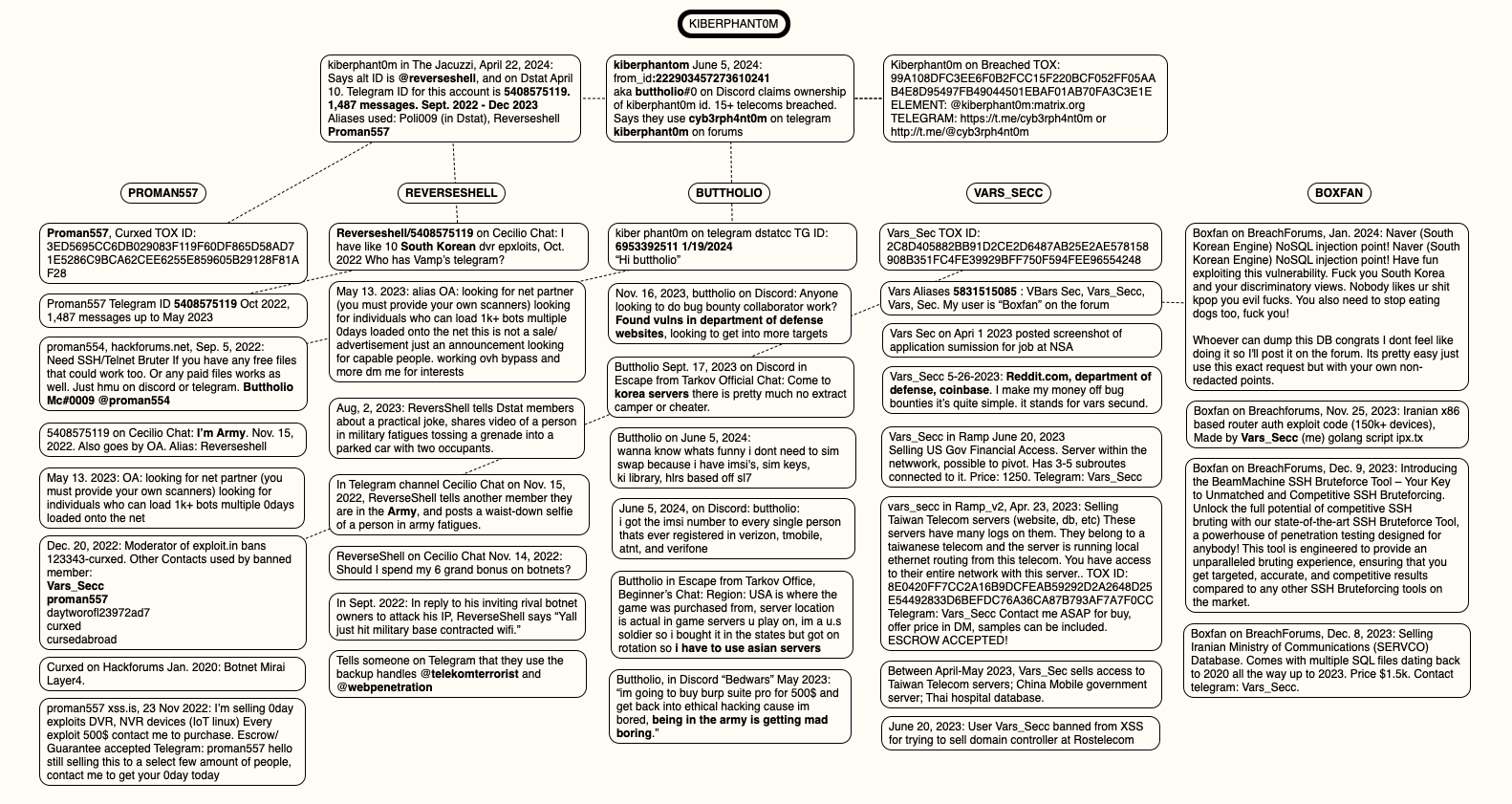
An anonymous reader quotes a report from KrebsOnSecurity: Two men have been arrested for allegedly stealing data from and extorting dozens of companies that used the cloud data storage company Snowflake, but a third suspect -- a prolific hacker known as Kiberphant0m -- remains at large and continues to publicly extort victims. However, this person's identity may not remain a secret for long: A careful review of Kiberphant0m's daily chats across multiple cybercrime personas suggests they are a U.S. Army soldier who is or was recently stationed in South Korea.

Kiberphant0m's identities on cybercrime forums and on Telegram and Discord chat channels have been selling data stolen from customers of the cloud data storage company Snowflake. At the end of 2023, malicious hackers discovered that many companies had uploaded huge volumes of sensitive customer data to Snowflake accounts that were protected with nothing more than a username and password (no multi-factor authentication required). After scouring darknet markets for stolen Snowflake account credentials, the hackers began raiding the data storage repositories for some of the world's largest corporations. Among those was AT&T, which disclosed in July that cybercriminals had stolen personal information, phone and text message records for roughly 110 million people. Wired.com reported in July that AT&T paid a hacker $370,000 to delete stolen phone records.

On October 30, Canadian authorities arrested Alexander Moucka, a.k.a. Connor Riley Moucka of Kitchener, Ontario, on a provisional arrest warrant from the United States, which has since indicted him on 20 criminal counts connected to the Snowflake breaches. Another suspect in the Snowflake hacks, John Erin Binns, is an American who is currently incarcerated in Turkey. Investigators say Moucka, who went by the handles Judische and Waifu, had tasked Kiberphant0m with selling data stolen from Snowflake customers who refused to pay a ransom to have their information deleted. Immediately after news broke of Moucka's arrest, Kiberphant0m was clearly furious, and posted on the hacker community BreachForums what they claimed were the AT&T call logs for President-elect Donald J. Trump and for Vice President Kamala Harris. [...] Also on Nov. 5, Kiberphant0m offered call logs stolen from Verizon's push-to-talk (PTT) customers -- mainly U.S. government agencies and emergency first responders.
Kiberphant0m denies being in the U.S. Army and said all these clues were "a lengthy ruse designed to create a fictitious persona," reports Krebs.

"I literally can't get caught," Kiberphant0m said, declining an invitation to explain why. "I don't even live in the USA Mr. Krebs." A mind map illustrates some of the connections between and among Kiberphant0m's apparent alter egos.
Software

RIP Delicious Library 37

Wil Shipley, announcing the end of Delicious Library, a media cataloging app: Amazon has shut off the feed that allowed Delicious Library to look up items, unfortunately limiting the app to what users already have (or enter manually).

I wasn't contacted about this.

I've pulled it from the Mac App Store and shut down the website so nobody accidentally buys a non-functional app.
John Gruber of DaringFireball adds: The end of an era, but it's kind of surprising it was still functional until now. (Shipley has been a full-time engineer at Apple for three years now.)

It's hard to describe just what a sensation Delicious Library was when it debuted, and how influential it was. Delicious Library was simultaneously very useful, in very practical ways, and obsessed with its exuberant UI in ways that served no purpose other than looking cool as shit. It was an app that demanded to be praised just for the way it looked, but also served a purpose that resonated with many users. For about a decade it seemed as though most popular new apps would be designed like Delicious Library. Then Apple dropped iOS 7 in 2013, and now, no apps look like this. Whatever it is that we, as an industry, have lost in the now decade-long trend of iOS 7-style flat design, Delicious Library epitomized it.
Businesses

China Woos Western Tech Talent in Race for Chip Supremacy (msn.com) 82

Chinese companies are aggressively recruiting foreign tech talent as a key strategy to gain technological supremacy, prompting national security concerns across Western nations and Asia, WSJ reported Wednesday, citing multiple intelligence officials and corporate sources. The campaign focuses particularly on advanced semiconductor expertise, with companies like Huawei offering triple salaries to employees at critical firms like Zeiss SMT and ASML, which produce essential components for cutting-edge chip manufacturing.

These recruitment efforts intensified after Western export controls restricted China's access to advanced technology. While Taiwan and South Korea have implemented strict countermeasures, including criminal penalties for illegal talent transfers, the U.S. and Europe struggle to balance open labor markets with national security concerns.

Chinese firms often obscure their origins through local ventures and persistent recruitment tactics. The strategy has shown results: Former employees have helped Chinese companies advance their technological capabilities, including SMIC's development of 7nm chips with help from ex-TSMC talent.

Slashdot Top Deals